
Eurovision Song Contest 2026 receives three certifications for sustainability

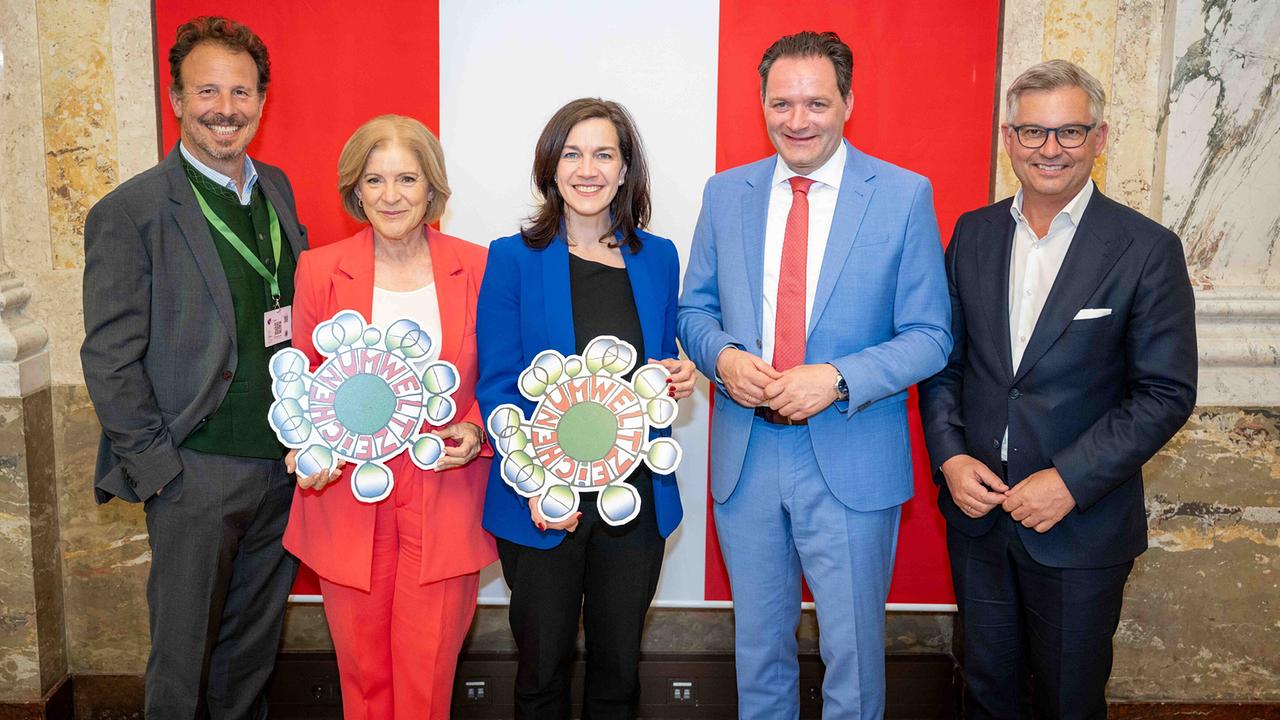
The Eurovision Song Contest 2026 officially received two state awards in sustainability on Saturday, May 9: the environmental seal for „Green Producing“ in film and television (UZ 76) and for „Green Event“ (UZ 62). Additionally, the silver certification from BIO AUSTRIA was awarded for the consistent use of organic food in catering.
Systematic approach to sustainability
The dual certification expresses a comprehensive sustainability concept that runs through all areas of the event: energy supply, mobility, procurement, and circular economy are systematically thought out and standardized.
With the environmental seal „green producing,“ the Eurovision Song Contest is breaking new ground. For the first time in ESC history, a fully LED and laser-based lighting system is being used on stage - a technological innovation that saves large amounts of energy and waste heat. Batteries are used instead of continuously running diesel generators as emergency backup. The material logistics are optimized to eliminate unnecessary trips.
Role model for the event industry
ORF is implementing a comprehensive green event concept at the Eurovision Song Contest. Specifically, this means: no disposable tableware and only reusable cups, most made from 100 percent recycled material. Waste reduction is consistently implemented - complete abstention from flyers, promotional items, and free newspapers, instead digital solutions wherever possible. In catering, ORF relies on a high organic quota with regionally and ecologically produced products from Austria. Unavoidable emissions are compensated.
„As Minister of Environment, it is a special pleasure for me to award ORF the environmental seals for Green Meetings and Events as well as for Green TV Producing at the Eurovision Song Contest 2026 and congratulate them on this success. With this, sustainability at this year's Song Contest is not just a buzzword, but concrete responsibility and consistent action: the organizers are not only making an important contribution to environmental and climate protection but also strengthening regional value creation - for example, by making regional procurement and the commissioning of local businesses standard rather than exception. With the certification of the Song Contest 2026, we are setting a strong signal - far beyond Austria's borders,“ says Federal Minister Norbert Totschnig.
Required organic quota exceeded
The organic share in the catering areas for the crew, media, delegations, and VIPs reached 64.3 percent - the targeted quota of 60 percent was thereby exceeded. In total, the ESC is supplying more than 100,000 people with certified organic offerings from Austrian agriculture.
The high organic quota was planned from the beginning: in the call for catering services, the high organic content was made a requirement. The consistent implementation of this criterion reflects ORF's fundamental approach at ESC 2026 - sustainability is not seen as a buzzword but as a measurable standard in all areas of the event.
„If organic catering on this scale succeeds at an international major event like the ESC, it has a great role model effect. It is to be hoped that many will take this as an example and that this success will contribute to establishing organic as a new standard in event catering,“ emphasized BIO AUSTRIA chairwoman Barbara Riegler.
Sustainability report sets course for the future
A special feature of ESC 2026 is the first comprehensive CO₂ accounting. Together with the City of Vienna, ORF is creating a scientifically based sustainability report that captures all emissions - from event operations to TV broadcasting and streaming. The calculation of the carbon footprint is supported by stakeholders, such as ASFINAG, ÖBB, or Vienna Airport. Additionally, volunteers on-site will assist with data collection - for example, by surveying guests on their arrival. The report will be published after the summer.
"We want not only to set sustainability measures but also to learn from them and pass on knowledge. These many initiatives and the sustainability report after the Eurovision Song Contest should make transparent how a TV mega-event works in the 21st century and how sustainability can be lived. This Song Contest leaves a ‚Sustainability Legacy’ - as an international best practice example for the entire EBU family. Our insights should serve as guidance for future Eurovision hosts," said Ingrid Thurnher, Director General of ORF.
ESC 2026 sets a new standard: World-class entertainment and consistent sustainability go hand in hand. What Vienna shows is not symbolism - it is practiced reality with measurable impact, intended to inspire future events worldwide.
(May 10, 2026)